
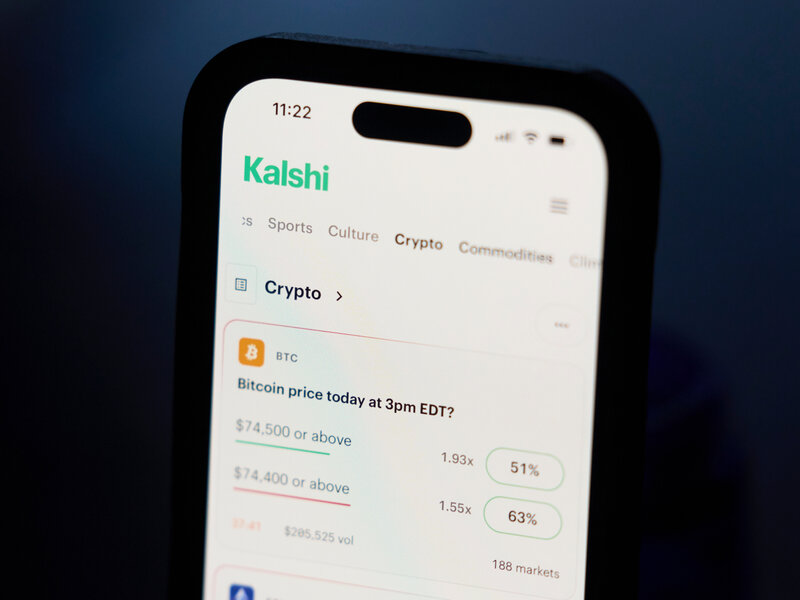

There is a number that deserves more attention than it has gotten. Technology and Science markets on prediction platforms grew 1,637% year over year in 2025. Economics markets followed at 905%. Politics — the category that got all the headlines, the think pieces, the congressional hearings — grew just 43%.
That asymmetry is the whole story. Everyone watched prediction markets call elections. The real action quietly moved somewhere else.
What Changed
Monthly transaction volume across prediction markets grew from $1.2 billion in early 2025 to over $20 billion in January 2026, with more than 800,000 unique wallets participating each month. That is not a bubble. That is an asset class finding its footing.
But volume alone doesn’t explain the shift. The more significant development is what people are now betting on. Macro events — Fed rate decisions, jobs reports, inflation data — are becoming the new battleground for liquidity. Which means traders are not using these platforms to guess election winners anymore. They are using them to price macroeconomic risk in real time, the same way a fixed income desk prices a rate move.
That is a categorically different thing. And Wall Street noticed.
The NYSE Move Nobody Fully Processed
In October 2025, ICE — the parent company of the New York Stock Exchange — announced a $2 billion investment in Polymarket at roughly a $9 billion valuation, granting ICE exclusive rights to distribute its event-driven data to institutional capital markets. Then, in February 2026, ICE launched its Polymarket Signals and Sentiment tool, which converts crowd-sourced prediction market probabilities into structured analytics that trading desks can layer on top of traditional data feeds.
Read that again. NYSE traders can now watch Polymarket odds shift in real time before a regulatory decision lands. Goldman Sachs CEO David Solomon has called prediction markets “super interesting” and confirmed a team is evaluating them. Goldman does not evaluate things for fun. When Goldman sends a team somewhere, they are looking for edge.
For a portfolio manager, the difference between traditional futures and data from a prediction platform is that the latter is a point-hedging tool — it allows protection against specific risks. If a client portfolio is sensitive to a particular regulatory decision or the outcome of a vote, traditional futures don’t provide sufficient exposure, since they primarily hedge continuous risks like oil prices or interest rates. The event contract triggers directly, providing a transparent and manageable protection mechanism.
That framing — prediction market as a surgical hedge rather than a speculative punt — is new. And it matters, because it determines how institutional capital flows in.
Interactive Brokers Just Made It Structural
The clearest sign that prediction markets have crossed a threshold: Interactive Brokers this month launched a first-of-its-kind unified interface for trading prediction markets across three leading US platforms — Kalshi, CME Group, and ForecastEx — sitting alongside stocks, options, futures, crypto, and bonds within a single, consolidated portfolio environment, built on institutional-grade infrastructure.
That is not a side product. That is a brokerage with decades of institutional credibility saying: this belongs in the same portfolio view as your equities. When IBKR makes that call, other brokers follow. Interactive Brokers’ founder Thomas Peterffy has said betting on the 2026 US midterm elections alone would be enough to accelerate the firm’s revenue growth this year. He is also reportedly backing prediction market startup Lumina Markets. He is not hedging. He is positioning.
The Iran Trade and Why It Matters
If you want a concrete example of prediction markets behaving like financial instruments — and occasionally outrunning them — look at what happened in late February.
On February 28, 2026, Polymarket set a single-day volume record of $425 million, driven almost entirely by Iran-related markets resolving simultaneously. The “Khamenei out as Supreme Leader of Iran by February 28” market surged from $23,000 in volume on February 27 to $29.6 million on February 28 — a 1,275x increase in a single day. Both sides of the market moved simultaneously, with the full market going from $930,000 to $39 million in 24 hours.
After the United States and Israel began strikes against Iran, a Polymarket account earned roughly $553,000 by betting on the removal of Iran’s supreme leader. This prompted recurring questions around high-stakes prediction markets: when does trading on superior information become insider trading, and how should that concept apply when the contract is not a share of stock but a prediction-market claim?
That question has no clean answer yet. But the fact that it is being asked at all — by law professors, by regulators, by financial journalists — tells you something about how seriously this market is now taken.
The Correlation Nobody Is Studying Yet
Here is the part that should be interesting to anyone managing capital.
Prediction markets are increasingly pricing events before traditional markets fully reflect them. The mechanism is simple: a decentralized crowd of traders with varying information sets bids contracts up or down based on what they know or believe. When the crowd has better average information than the consensus embedded in equity prices — which happens more than people admit — the prediction market moves first.
Some quantitative traders are already using API access to explore algorithmic approaches that treat event contracts with similar analytical rigor as other instruments. Historical data availability, limited on newer platforms but improving, supports backtesting and model development. That is the early signal. The quant shops that got into crypto in 2015 and 2016 are the same type of shops running these API strategies now. They are not doing it for the novelty.
AI integration introduces new considerations. Automated systems may amplify herding behavior if multiple agents converge on similar signals or training data. As AI participation scales, market dynamics may shift in ways that affect liquidity depth, volatility patterns, and the speed of price discovery. In other words, the feedback loops are getting faster and harder to trace. That is a feature from a liquidity standpoint and a risk from a manipulation standpoint, and both things are true at the same time.
The Volume Caveat
One number worth handling carefully. Polymarket’s volume figures may significantly overstate actual economic activity, due to its NegRisk market structure causing certain on-chain trackers to record both sides of a trade as independent transactions. Kalshi’s $23.8 billion figure, derived from cleaner fiat accounting, is a more apples-to-apples measure of real economic volume.
The headline numbers are real enough to take seriously. But anyone building a thesis on prediction market size should be working from the Kalshi fiat figures, not the on-chain aggregates. The signal is genuine. The magnitude needs adjusting.
Where This Goes
CNBC cited an industry report projecting prediction markets could hit $1.1 trillion by 2030, with the longer-term structural bet on economics and macro becoming the dominant category, overtaking sports and politics as institutional players bring serious capital to Fed decisions, jobs reports, and geopolitical event contracts.
Traditional asset protection models no longer work as effectively as they used to in the current geopolitical environment. That is why prediction markets will become more regulated and will finally move out of the uncertain zone. The rise of Polymarket or the legalization of Kalshi is not a temporary or accidental phenomenon — they are clear markers of the formation of a new industry.
The financial system has spent two years treating prediction markets as an interesting sideshow. The NYSE, Goldman Sachs, Interactive Brokers, CME Group, and DraftKings are not sideshows. They do not put capital and infrastructure into interesting sideshows. They put capital into things that are about to be structural.
The odds on that shift are already priced in. The question is whether the traditional financial press has caught up yet.